




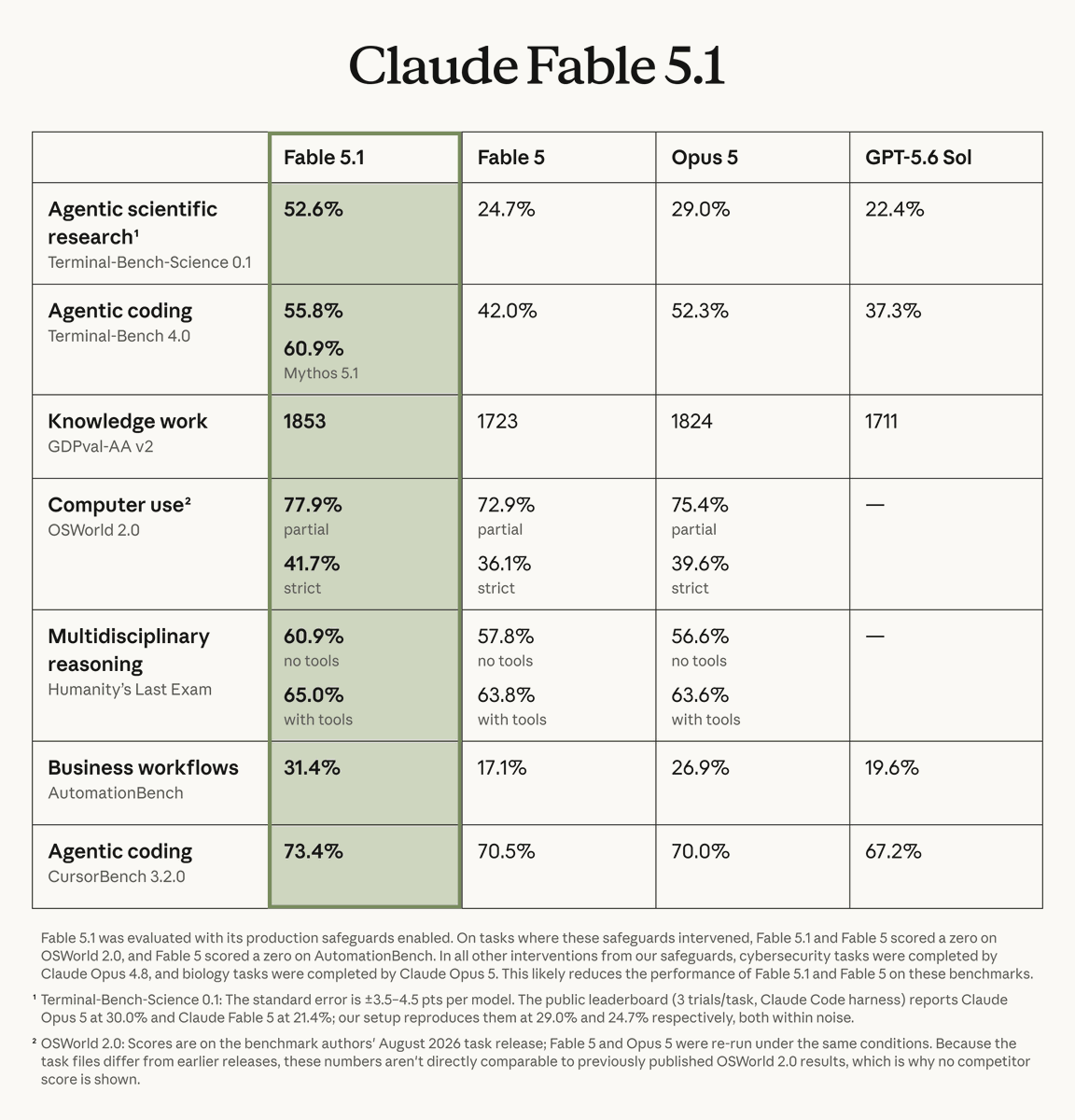
Fable 5.1 Tops Opus 5 on Terminal-Bench 4.0
On Terminal-Bench 4.0 inside Claude Code, Fable 5.1 scores 55.8%, beating both Fable 5 (42%) and Opus 5 (52.3%). It leads across agentic coding and computer use evals.
ClaudeDevs·Tue, Sep 1 2:13pm ET
On Terminal-Bench 4.0 inside Claude Code, Fable 5.1 scores 55.8%, beating both Fable 5 (42%) and Opus 5 (52.3%). It leads across agentic coding and computer use evals.
Fable 5.1 is live in Claude Code and the Claude Platform. Same price as Fable 5, with 75% cheaper cache reads. It handles longer tasks before needing user input, better signals when it's stuck, and writes more naturally.
All users get fresh 5-hour and weekly usage limits reset alongside the Fable 5.1 launch today.
Fable 5.1 leads across coding, data analysis, computer use, design, presentations, and long-running agentic tasks. The Claude Code team calls it a pleasure to work with and describes it as their best model yet.
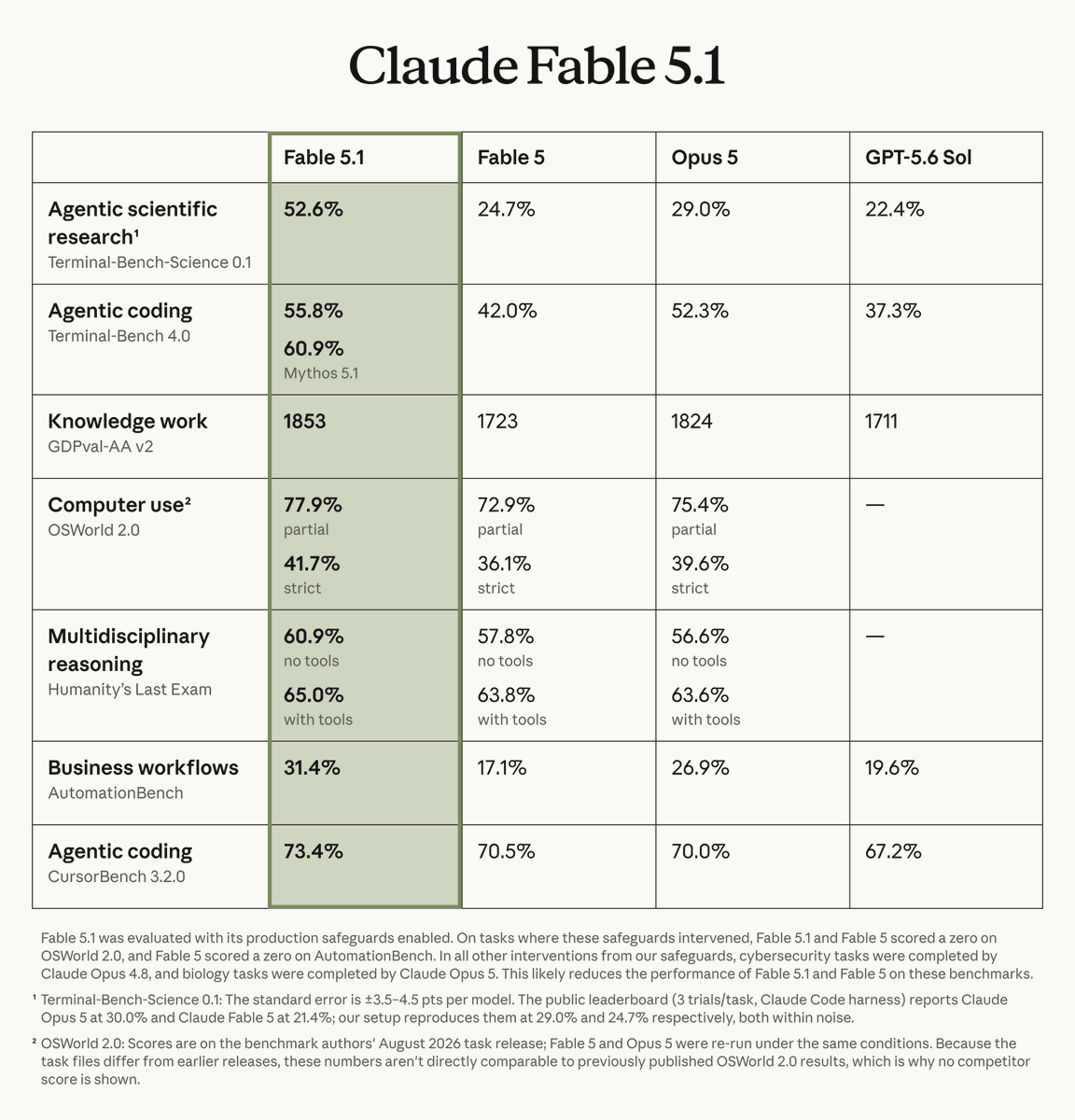
Fable 5.1 and Mythos 5.1 are out. Key improvements: the model goes deeper into tasks before asking for help, admits when it is stuck rather than faking progress, and fixes root causes instead of reaching for quick patches. Cache reads are 75% cheaper; base price unchanged.
Cache read pricing for Fable 5.1 falls from $1 to $0.25 per million tokens for Enterprise, API, and SDK customers. A typical Claude Code session works out roughly 38% cheaper as a result.
Cache read pricing stays at $0.25/MTok for Fable 5.1, down from $1/MTok on Fable 5, with subscription pricing unchanged. Long Claude Code sessions billed at API rates can net out 25% to 45% cheaper for prompt cache-optimized workloads.
Cache reads have always counted at a reduced rate toward subscription usage, so the pricing change affects usage-based billing only. Subscription usage on Max plans remains the same as with Fable 5.
The latest biology safeguards intervene on benign requests 85% less often than those shipped with Fable 5. Claude Code users can expect around 60% fewer cyber interventions per session, with further improvements on the way.
Improved cyber safeguards in Fable 5.1 let it handle vulnerability scanning in user source code directly. Cyber-related fallbacks to Opus are down about 40% from Fable 5 at launch, and 55% from where Fable 5 started.
To counter distillation attacks that extract chain-of-thought, the Messages API will no longer allow editing Claude's context prior to thinking blocks in multi-turn conversations. The change currently applies only to new accounts using Fable 5.1 and is planned to roll out to all users for future model releases.
An Anthropic demo developer used Fable 5.1 to build a Mac app that tracks overhead flights and announces their position out loud, describing the model as one that 'just gets it' without much back-and-forth.
A turn-by-turn navigation app for the Moon built on actual NASA terrain data, rendered as a 3D globe with no libraries, routes between craters while steering around the largest ones and explaining each decision.
Asked to explain how a combustion car engine works, Fable 5.1 produced an interactive browser-based visual rather than a text explanation.
The primary design goal for Fable 5.1 was increasing intelligence while keeping it safely accessible, leading to the pricing and safety changes detailed in the broader thread.
Writing quality and tone are better in Fable 5.1, with active work underway to reduce Claude-speak. The team says 5.1 shows solid progress on this dimension, with more improvements coming.