




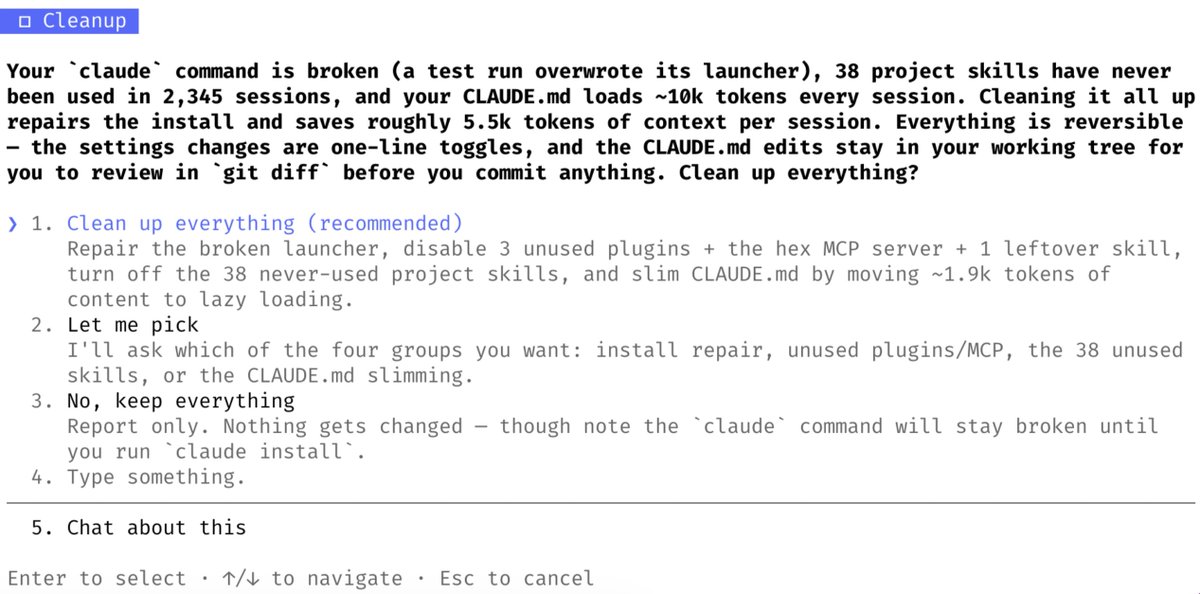
/checkup Results Shared After First Run
A screenshot shows what actually happened when /checkup was run on a real project, giving a concrete look at the kinds of cleanup and optimization changes the new command proposes.
bcherny·Wed, Jul 8 7:22pm ET
A screenshot shows what actually happened when /checkup was run on a real project, giving a concrete look at the kinds of cleanup and optimization changes the new command proposes.
All users have had their 5-hour and weekly rate limits reset. No additional context was given on why or whether this is a one-time event.
Following the rate limit reset, an Anthropic team member called out Fable specifically as something users can now get back to building or playing with.
A new /checkup slash command audits and optimizes your Claude Code setup: it removes unused skills, MCPs, and plugins; deduplicates CLAUDE.md files; splits monolithic configs into nested ones; disables slow hooks; updates Claude Code to the latest version; enables auto mode by default; and pre-approves common read-only commands. It asks for confirmation before making any changes.
In response to a user scrambling to maximize Claude usage before a rate limit reset, an Anthropic team member suggested launching multiple /goals commands as a way to keep Claude productive across a long session, like a cross-country flight.
Bun published a blog post detailing its rewrite from Zig to Rust, a project that involved extensive use of Claude Code during development.
For the Bun Rust rewrite post, Claude was prompted to read draft sections, search for related coverage, and predict Hacker News reactions, then suggest edits. The final text was entirely human-written; Claude functioned as a research and critique layer.
The interactive build-timeline visualizations in the Bun blog post were generated by prompting Claude to download all BuildKite annotations for a branch, analyze the JSON, and produce a React component showing per-platform build status as a timeline.
Reflecting on the Claude-assisted Bun Rust rewrite, an Anthropic team member argues this should update how engineers think about rewrites generally: they can be cheap, fast, and good when the codebase is well-tested, and models will keep improving at handling the cases where it isn't.
Despite heavy use of Claude for editing and feedback, essentially none of the actual text in the Bun Rust rewrite blog post came from Claude. It helped shape the draft through critique and web search, but the writing itself was human.
Claude Code was run inside a tmux session on a remote machine accessed via SSH, rather than locally, for the Bun rewrite work.
Running multiple parallel Claude workflows doesn't require multiple Claude Code tabs. A single session can orchestrate up to four concurrent workflows, each spawning up to roughly 16 subagents, for a total of around 64 Claudes running from one entry point.
For projects over roughly 300 lines of code, a long-running orchestrator context that writes and monitors workflows works better than a single sprawling agent session. Each sub-agent runs with a clean context, which avoids accumulated bias and keeps outputs reliable.
In response to complaints that artifacts can't be shared, downloaded, or printed, an Anthropic team member confirms broader sharing is actively being worked on, with more artifact features coming.
Following user frustration over artifact limitations, an Anthropic team member floats adding a download button for the HTML file or a print button as potential fixes.