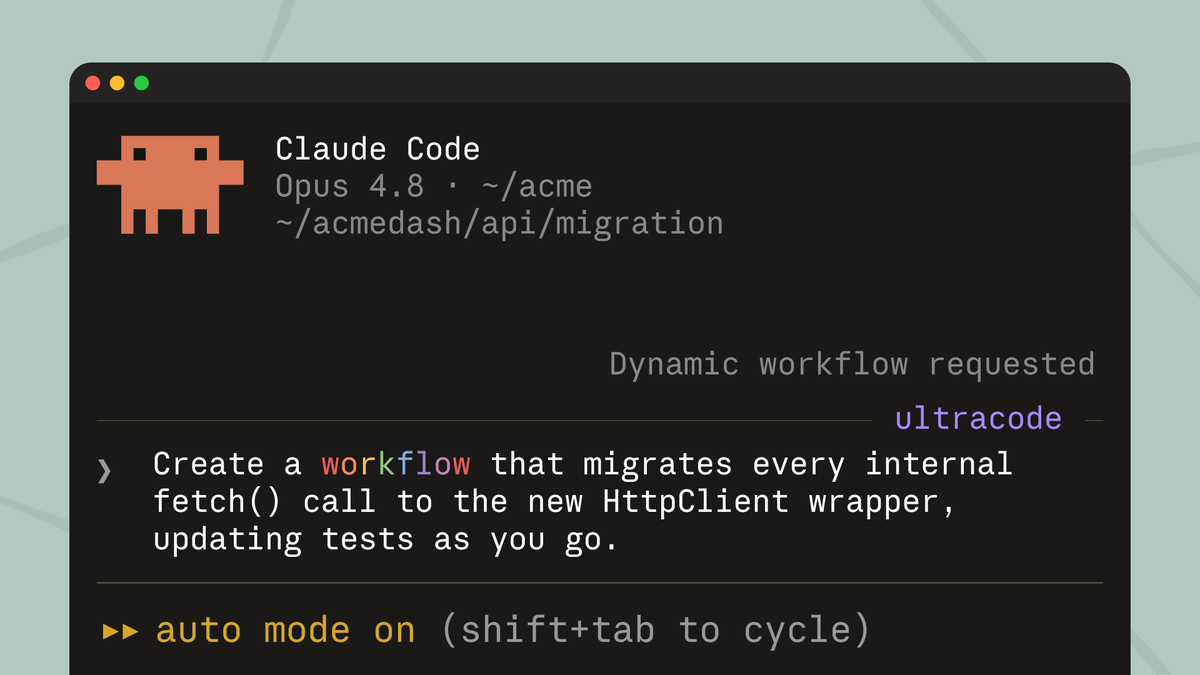
Opus 4.8 is now live and positioned as the recommended model for everyday Claude Code use. The headline behavioral change is improved honesty: it flags problems in its own code and admits uncertainty rather than papering over issues.
_catwu·Thu, May 28 1:31pm ET
A dedicated prompting guide for Opus 4.8 is now live, covering tips and best practices for getting the most out of the model.
ClaudeDevs·Thu, May 28 1:04pm ET
The model flag uses a hyphen, not a decimal point. The correct syntax is --model=claude-opus-4-8, and the dot variant (claude-opus-4.8) does not work.
bcherny·Thu, May 28 2:25pm ET
Jarred Sumner used dynamic workflows to port roughly 750k lines of Bun from Zig to Rust in 11 days, reaching 99.8% test suite pass rate, with hundreds of agents running in parallel and two reviewers assigned to every file.
_catwu·Thu, May 28 1:31pm ET
Dynamic workflows combined with adversarial code review were the key techniques behind rewriting Bun in Rust in six days, offered as a concrete proof point for the approach.
jarredsumner·Thu, May 28 1:28pm ET
A reliable three-phase loop for each unit of work: do the work (no slow commands), run adversarial review, then apply changes. Works for bulk rewrites like porting every .zig file to Rust or getting a whole crate tree to compile.
jarredsumner·Thu, May 28 1:28pm ET
A concrete workflow pattern: step one fixes a bug from a report file, step two spins up two adversarial review agents to poke holes in the fix. Git and build commands are banned per step to avoid conflicts when multiple Claude instances share a branch.
jarredsumner·Thu, May 28 1:28pm ET
Each workflow step shares the same prompt template but runs in a forked context window, making the process more deterministic than open-ended subagent delegation. The mental model is closer to a custom build pipeline than a chat session.
jarredsumner·Thu, May 28 1:28pm ET
Giving each workflow step its own context window keeps Claude focused on exactly the task at hand, which empirically improves results. Individual workflows have been observed running for 10 hours continuously.
jarredsumner·Thu, May 28 1:28pm ET
You can tell Claude roughly how many tokens to spend, nudging it toward thoroughness on hard tasks and frugality on easy ones. This works especially well inside dynamic workflows.
jarredsumner·Thu, May 28 1:28pm ET
Salesforce published a detailed writeup on adopting Claude Code at scale. A migration originally scoped at 231 days shipped in 13, and one PR delivered 21 endpoints at 100% test coverage.
bcherny·Fri, May 29 12:00pm ET
Despite a large increase in shipping velocity, total incidents dropped 5%. Security guardrails and quality standards were built directly into the agentic workflow, which challenges the usual assumption that speed and quality trade off against each other.
bcherny·Fri, May 29 12:00pm ET