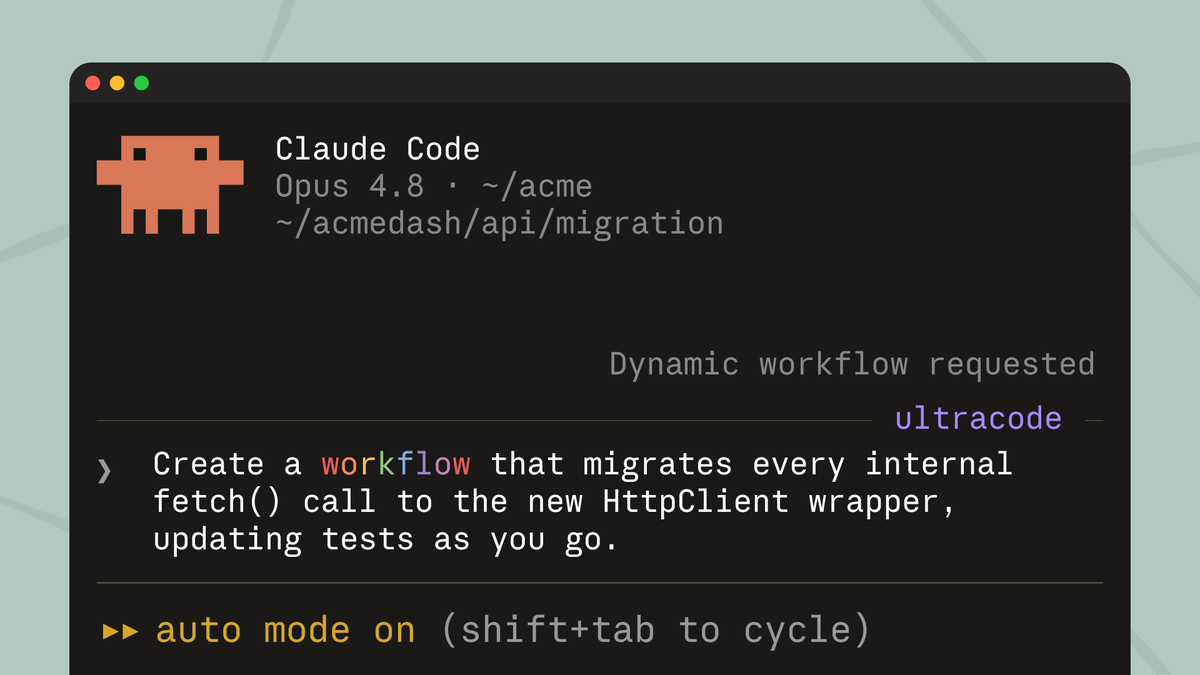
Dynamic workflows are designed for work that outgrows a single agent loop: think service-wide bug hunts, large migrations, or stress-testing a system design. They can burn through tokens quickly, so starting with a scoped task is strongly recommended.
ClaudeDevs·Thu, May 28 1:05pm ET
Dynamic workflows are reusable: save one as a slash command inside a project to share it with teammates, or in your home directory to make it available everywhere.
ClaudeDevs·Thu, May 28 1:05pm ET
A blog post covers how dynamic workflow orchestration works under the hood and showcases what early users have already built with it.
ClaudeDevs·Thu, May 28 1:05pm ET
The standout new capability in this release is dynamic workflows: Claude now plans a task, fans it out to tens or hundreds of parallel subagents, verifies their outputs, and iterates until everything converges into a single coordinated answer.
adocomplete·Thu, May 28 4:04pm ET
Big refactors and migrations, the work teams perpetually defer, can now land in days or weeks instead of tying up engineers for a quarter. The announcement links to more detail on dynamic workflows.
bcherny·Thu, May 28 1:21pm ET
A concrete internal use case: dynamic workflows were used to catalogue hundreds of A/B test flags and identify ones rolled out to 0% or 100% for deprecation, with subagents working in parallel rather than sequentially.
_catwu·Thu, May 28 1:42pm ET
A new effort level called "ultracode" runs at xhigh and lets Claude autonomously decide when a task is complex enough to warrant spinning up a dynamic workflow, without you having to prompt for it explicitly.
ClaudeDevs·Thu, May 28 1:05pm ET
Dynamic workflows combined with adversarial code review were the key techniques behind rewriting Bun in Rust in six days, offered as a concrete proof point for the approach.
jarredsumner·Thu, May 28 1:28pm ET
Jarred Sumner used dynamic workflows to port roughly 750k lines of Bun from Zig to Rust in 11 days, reaching 99.8% test suite pass rate, with hundreds of agents running in parallel and two reviewers assigned to every file.
_catwu·Thu, May 28 1:31pm ET
A reliable three-phase loop for each unit of work: do the work (no slow commands), run adversarial review, then apply changes. Works for bulk rewrites like porting every .zig file to Rust or getting a whole crate tree to compile.
jarredsumner·Thu, May 28 1:28pm ET
A concrete workflow pattern: step one fixes a bug from a report file, step two spins up two adversarial review agents to poke holes in the fix. Git and build commands are banned per step to avoid conflicts when multiple Claude instances share a branch.
jarredsumner·Thu, May 28 1:28pm ET
You can tell Claude roughly how many tokens to spend, nudging it toward thoroughness on hard tasks and frugality on easy ones. This works especially well inside dynamic workflows.
jarredsumner·Thu, May 28 1:28pm ET