Claude Code Gets Auto-Continue After Usage Limit
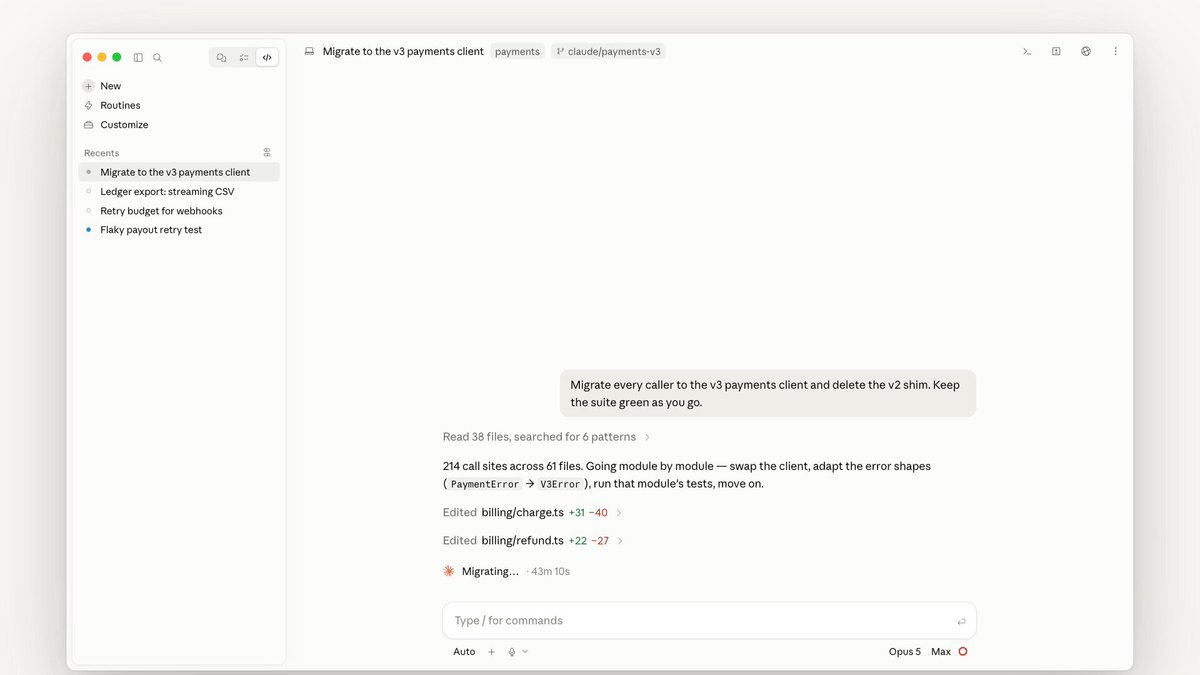
A new checkbox in Claude Code desktop lets you opt in to automatic continuation once your usage limit resets, so long-running sessions don't stall waiting for manual intervention.

A new checkbox in Claude Code desktop lets you opt in to automatic continuation once your usage limit resets, so long-running sessions don't stall waiting for manual intervention.
Auto mode has officially rolled out as the default permission mode for Pro, Max, and Team users. Existing users who already set a default mode will be prompted before anything changes; you can still switch modes anytime with Shift+Tab or lock one in via the 'defaultMode' setting.
Running /auto-mode-setup lets Claude scan your repo and suggest trusted repos and domains for the auto mode classifier. The more context the classifier has about your environment, the more precisely it can distinguish safe from dangerous commands.
Subagents can be given persistent memory by setting the 'memory' field to user, local, or project, giving them context that survives across sessions. Subagents also load CLAUDE.md by default.

A multi-week experiment using Claude Tag to run automated daily routines across iOS, Android, desktop, web, CLI, and Agent SDK repos: crash fuzzing, dead-code removal, abstraction cleanup, and more. The setup produced 388 PRs over a few weeks, with 180 merged after Claude Code Review plus human sign-off. The team is now looking at how to streamline merging of mechanical changes at scale.
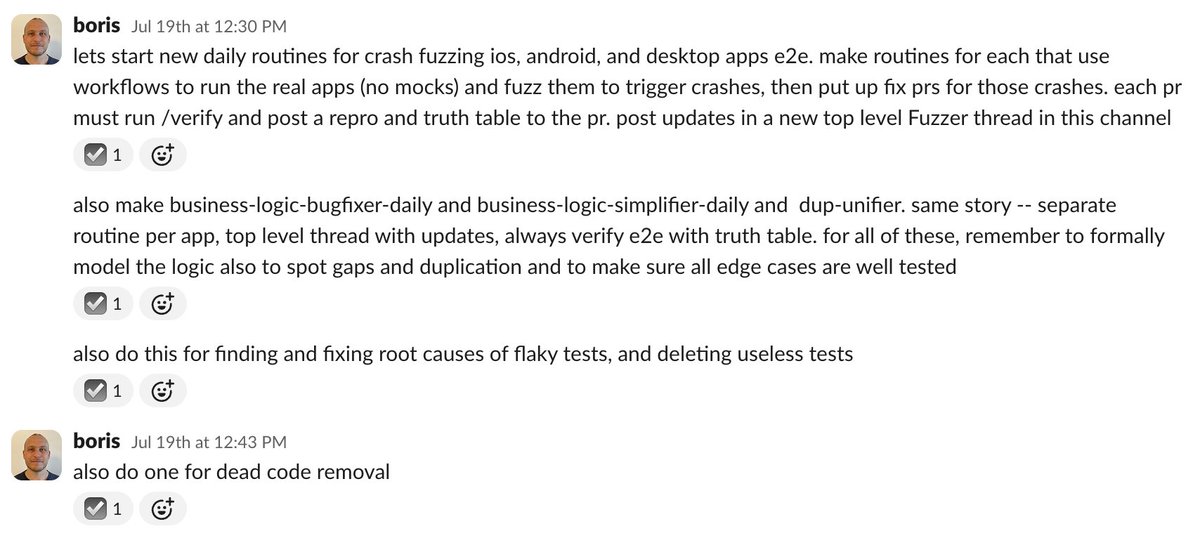
Boris Cherny published the exact prompt he used to spin up automated crash-fuzzing routines for iOS, Android, and desktop apps. The routine runs real apps (no mocks), fuzzes them to surface crashes, and then files fix PRs that each include a repro and truth table, posting updates to a dedicated Fuzzer thread. He also clarified that dead-code removal goes beyond static analysis tools like knip, covering cases those tools can't handle.
Of the roughly 208 unmerged PRs in Boris Cherny's automated routine pipeline, most are simply unreviewed rather than bad. He estimates about 1 in 50 is noise, and when that happens the team tunes the routine that generated them.
Responding to frustration that continuing a session requires a toggle instead of just working automatically, Boris Cherny explained the toggle exists to prevent unexpected usage burns. The choice of whether to continue and consume tokens should remain the user's.
Boris Cherny confirmed that Sonnet 5 can handle most of the automated PR and routine tasks he described, though users should budget more time for auditing PRs and iterating on prompts, plus adding checks and guardrails, compared to using Opus 5.
A user asked for a particular session setting to become the default across Claude Code CLI, Claude Desktop, Cowork, and everything else. Tom responded confirming the team is working on it.
A developer with roughly 15 years on VS Code at Microsoft has joined Anthropic to work on the Claude Code desktop app.
The desktop app's diff view (just above the input box) is hardcoded against the main branch, and starting a new session with a worktree defaults to main as well. The CLI's --worktree flag appears to share this limitation, with no option to change the target branch.