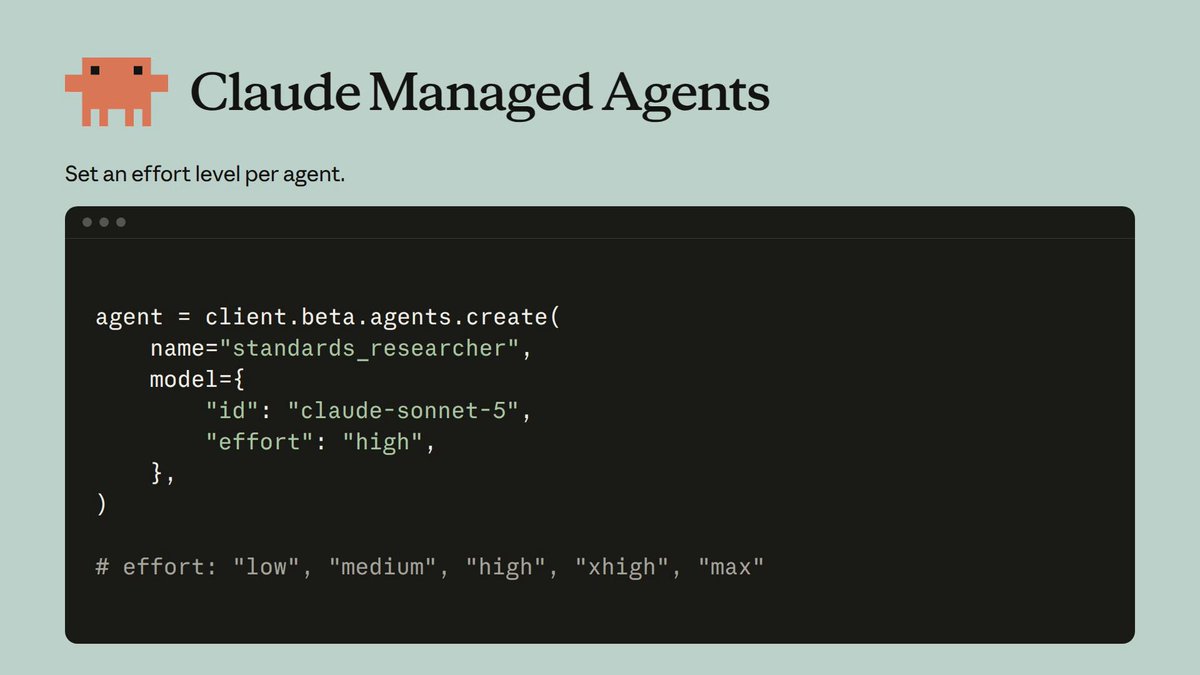
Skills provide task-specific instructions to Managed Agents. You can now add up to 500 skills across all Managed Agents in a single session, up from the previous limit.
ClaudeDevs·Wed, Jul 22 3:18pm ET
A cookbook for the new Managed Agents features is available, alongside the built-in "claude-api" skill for asking Claude Code about the updates directly, and full release notes.
ClaudeDevs·Wed, Jul 22 3:18pm ET
You can set effort level per subagent by adding an `effort` field to the subagent's YAML frontmatter alongside `name` and `model`. This lets you tune effort independently from the parent session rather than relying solely on model selection.
lydiahallie·Wed, Jul 22 11:26am ET
A user asked for subagents to spawn with isolated sessions and return only short summaries to keep the main agent's context lean. Subagents already run in fresh contexts, and only their final message is returned to the main agent; the team is asking for specifics if users are still seeing context blowup.
lydiahallie·Wed, Jul 22 12:46am ET
A user requested a command to hand off prompts from the main agent into a fresh context. The response floats '/subtask' as a possible name, with a screenshot suggesting it may already be in consideration.
lydiahallie·Wed, Jul 22 12:55am ET
A user asked about accessing projects from their phone without being at their desktop. The '/remote-control' command keeps a session running on the local machine while allowing you to continue it from the Claude mobile app or web.
lydiahallie·Tue, Jul 21 11:58pm ET
A user wanted to enable '/remote-control' globally without typing it each time. The setting lives in '/config' under 'Enable Remote Control for all sessions'.
lydiahallie·Wed, Jul 22 12:05am ET
A user wanted to start a session in the terminal and continue it in the Claude Code desktop app. The '/desktop' command does exactly that, transferring the active session over.
lydiahallie·Wed, Jul 22 12:06am ET
A user requested the ability to branch chat conversations. The feature already exists via the /branch slash command.
lydiahallie·Wed, Jul 22 11:35am ET
Version 2.1.217 adds emoji shortcode support to the prompt input. Type `:heart:` and it converts to the emoji; type a partial like `:hea` and suggestions appear as you type. The behavior can be toggled via the `emojiCompletionEnabled` setting.
adocomplete·Wed, Jul 22 11:28am ET
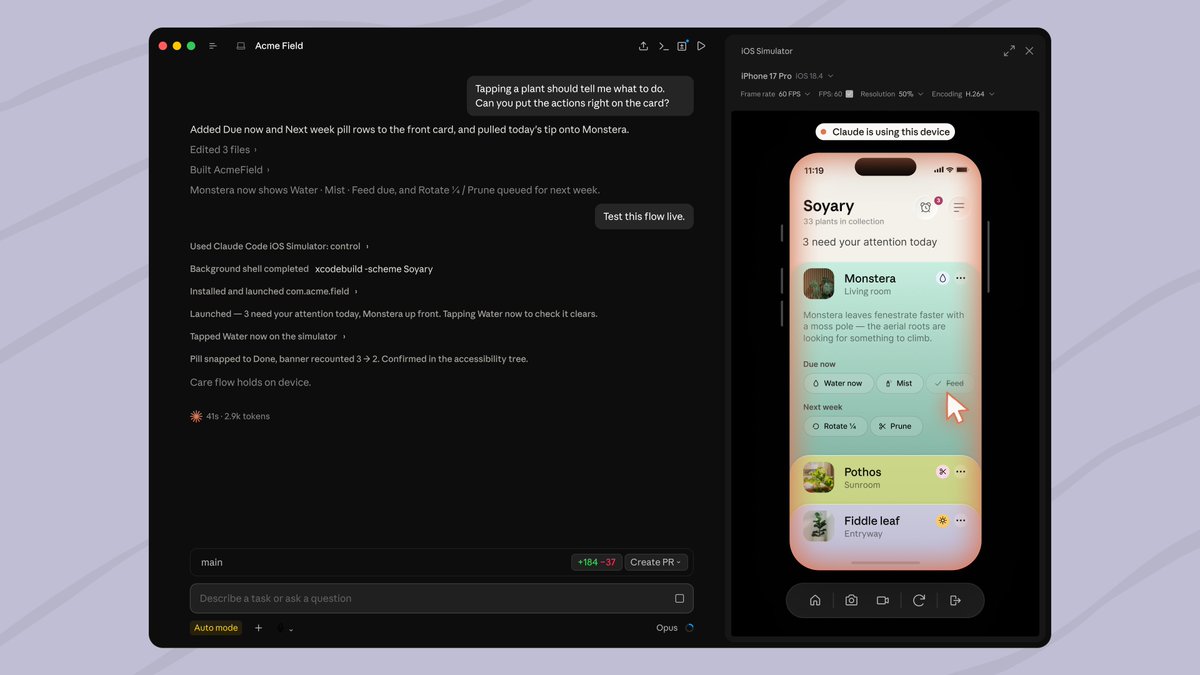
The Claude Code Desktop app has reached the point where an Anthropic team member uses it for all daily coding. Key features cited: multiple workflow management, built-in browser and iOS simulator, file explorer, git, terminal, and easier settings.
adocomplete·Wed, Jul 22 3:00pm ET
Bun v1.4 will be the runtime's biggest Node.js compatibility jump since v1.0. One engineer pairing with Claude Code passed more of Node's test suite in a single month than the entire Bun team did across nine months between v1.2 and v1.3.
jarredsumner·Wed, Jul 22 2:36pm ET